<?xml version="1.0" encoding="UTF-8"?>
<feed xmlns="http://www.w3.org/2005/Atom">
    <title>StoryCog</title>
    <link rel="alternate" type="text/html" href="http://storycog.com/blog/" />
    <link rel="self" type="application/atom+xml" href="http://storycog.com/blog/atom.xml" />
    <id>tag:storycog.com,2011-04-02:/blog//2</id>
    <updated>2013-04-15T13:16:11Z</updated>
    
    <generator uri="http://openmelody.org/">Melody 1.0.0 (RC 2, build 36)</generator>

<entry>
    <title>Pendulums</title>
    <link rel="alternate" type="text/html" href="http://storycog.com/blog/2013/04/pendulums/" />
    <id>tag:storycog.com,2013:/blog//2.43</id>

    <published>2013-04-15T13:16:07Z</published>
    <updated>2013-04-15T13:16:11Z</updated>

    <summary>Over at StoryCog side-project ScienceDemo.org, it&#8217;s Pendulum Week! Be sure to visit for your daily dose of swing-based inspiration. (Yes, we know this is a bit weird. Roll with it, we&#8217;re still exploring what we want ScienceDemo.org to be: feedback...</summary>
    <author>
        <name>Jonathan</name>
        
    </author>
    
        <category term="science communication" scheme="http://www.sixapart.com/ns/types#category" />
    
    <category term="demonstrations" label="demonstrations" scheme="http://www.sixapart.com/ns/types#tag" />
    <category term="links" label="links" scheme="http://www.sixapart.com/ns/types#tag" />
    <category term="projects" label="projects" scheme="http://www.sixapart.com/ns/types#tag" />
    <category term="scicomms" label="scicomms" scheme="http://www.sixapart.com/ns/types#tag" />
    <category term="science" label="science" scheme="http://www.sixapart.com/ns/types#tag" />
    
    <content type="html" xml:lang="en" xml:base="http://storycog.com/blog/">
        <![CDATA[<p>Over at StoryCog side-project <a href="http://sciencedemo.org">ScienceDemo.org</a>, it&#8217;s Pendulum Week! Be sure to visit for your daily dose of swing-based inspiration.</p>

<p>(Yes, we know this is a bit weird. Roll with it, we&#8217;re still exploring what we want ScienceDemo.org to be: feedback welcome!)</p>
]]>
        

    </content>
</entry>

<entry>
    <title>Craft</title>
    <link rel="alternate" type="text/html" href="http://storycog.com/blog/2013/04/craft/" />
    <id>tag:storycog.com,2013:/blog//2.42</id>

    <published>2013-04-10T22:29:34Z</published>
    <updated>2013-04-11T10:06:23Z</updated>

    <summary>Another unapologetically out-of-context quote from Matterson&#8217;s article at the BSA: &#8220;Those providing informal learning tend to be driven by their passion and creativity. They evaluate their activities, but the evaluations tend to be locally derived, formative and not linked to...</summary>
    <author>
        <name>Jonathan</name>
        
    </author>
    
        <category term="science communication" scheme="http://www.sixapart.com/ns/types#category" />
    
    <category term="policy" label="policy" scheme="http://www.sixapart.com/ns/types#tag" />
    <category term="reports" label="reports" scheme="http://www.sixapart.com/ns/types#tag" />
    <category term="strategy" label="strategy" scheme="http://www.sixapart.com/ns/types#tag" />
    
    <content type="html" xml:lang="en" xml:base="http://storycog.com/blog/">
        <![CDATA[<p>Another unapologetically out-of-context quote from <a href="http://www.britishscienceassociation.org/people-science-magazine/march2013/science-beyond-classroom">Matterson&#8217;s article at the BSA</a>:</p>

<blockquote>
  <p>&#8220;Those providing informal learning tend to be driven by their passion and creativity.  They evaluate their activities, but the evaluations tend to be locally derived, formative and not linked to research. [&#8230;] It seems that practitioners can best be characterised as craftspeople, operating through a model of apprenticeship, observation and audience approval. This contrasts with the &lsquo;professional&rsquo; tradition whereby formalised mechanisms are developed to record knowledge and train new and existing entrants.&#8221;</p>
</blockquote>

<p>One of my problems with UK science communication is that it&#8217;s managed largely by scientists, who are highly trained to recognise and value only things they can categorise and/or measure.</p>

<blockquote>
  <p>&#8220;There are more things in heaven and earth, Horatio, <br />
Than are dreamt of in your philosophy.&#8221;</p>
</blockquote>

<p>I&#8217;m a film-maker. I&#8217;m proud to be a craftsman. When behind the lens I delight in the play of light over form; as a director I seduce my presenters into delicate subtlety and nuance, and I obsess over individual edits to a level of finesse my clients will never notice. I&#8217;m never satisfied, and it&#8217;s always the <em>next</em> film which might reach the standards I set for myself.</p>

<p>My point in the previous post was intended to be: if we aim for science to be a cultural activity, we have to engage with the language and practices of culture. The objectives of cultural activities are rarely &#8216;learning outcomes&#8217;, they&#8217;re often far less tangible.</p>

<p>This is why I&#8217;ve always been wary of the &#8216;evaluation is the only true measure of success&#8217; line of thinking. Evaluation <em>is</em> tremendously important and valuable, but it doesn&#8217;t capture everything. It doesn&#8217;t always tell you if something&#8217;s plain shit.</p>

<p><em>[&#8212;edited for clarity, 11/4/2013]</em></p>
]]>
        

    </content>
</entry>

<entry>
    <title>I am not an &apos;educator&apos;</title>
    <link rel="alternate" type="text/html" href="http://storycog.com/blog/2013/04/i-am-not-an-educator/" />
    <id>tag:storycog.com,2013:/blog//2.41</id>

    <published>2013-04-10T22:26:22Z</published>
    <updated>2013-04-11T09:58:57Z</updated>

    <summary>One of things I rather like about the UK STEM engagement scene is that we haven&#8217;t started using the US phrase &#8220;Informal Science Education.&#8221; I&#8217;ve tremendous respect for education, but the word doesn&#8217;t capture all of what I&#8217;ve been doing...</summary>
    <author>
        <name>Jonathan</name>
        
    </author>
    
        <category term="science communication" scheme="http://www.sixapart.com/ns/types#category" />
    
    <category term="policy" label="policy" scheme="http://www.sixapart.com/ns/types#tag" />
    <category term="reports" label="reports" scheme="http://www.sixapart.com/ns/types#tag" />
    <category term="strategy" label="strategy" scheme="http://www.sixapart.com/ns/types#tag" />
    
    <content type="html" xml:lang="en" xml:base="http://storycog.com/blog/">
        <![CDATA[<p>One of things I rather like about the UK STEM engagement scene is that we haven&#8217;t started using the US phrase &#8220;Informal Science Education.&#8221; I&#8217;ve tremendous respect for education, but the word doesn&#8217;t capture all of what I&#8217;ve been doing for the last twenty years. So I get a little worried when I read articles like that by <a href="http://www.britishscienceassociation.org/people-science-magazine/march2013/science-beyond-classroom">Clare Matterson at the BSA site</a>.</p>

<p>Amongst a few sweeping statements (&#8220;Those between five and 16 years old are well served&#8221;?), these phrases occur in consecutive paragraphs:</p>

<blockquote>
  <p>&#8220;We need a basket of &#8216;killer facts&#8217; to show that informal learning is not a &#8216;nice to have&#8217;, but a critical component of effective science education.&#8221;  </p>
</blockquote>

<p>&amp;  </p>

<blockquote>
  <p>&#8220;Adults are under-served, suggesting that messages about the cultural importance of science to adult society are neglected.&#8221;</p>
</blockquote>

<p>Hang on: we&#8217;ve gone from &#8216;informal education&#8217; to &#8216;learning&#8217; to (what appears to be) &#8216;formal education&#8217;, and now to &#8216;culture&#8217;. Which is it?</p>

<p>We&#8217;re not going to progress the cultural aspirations of science by using the tools of formal education to measure that progress.</p>

<p><em>[&#8212;edited for clarity 11/4/2013]</em></p>
]]>
        

    </content>
</entry>

<entry>
    <title>Showreel</title>
    <link rel="alternate" type="text/html" href="http://storycog.com/blog/2013/03/showreel/" />
    <id>tag:storycog.com,2013:/blog//2.40</id>

    <published>2013-03-25T15:47:39Z</published>
    <updated>2013-03-25T15:53:22Z</updated>

    <summary> We&#8217;ve (finally) cut a showreel. It features Richard Dawkins, Dava Sobel, Steven Pinker, David Attenborough, Jem Stansfield, Bruce Hood, Alok Jha, Matt Parker, Jon Butterworth&#8230; and a lobster. Showreels, it turns out, are hard. In our case, we&#8217;re aware...</summary>
    <author>
        <name>Jonathan</name>
        
    </author>
    
        <category term="admin" scheme="http://www.sixapart.com/ns/types#category" />
    
        <category term="films" scheme="http://www.sixapart.com/ns/types#category" />
    
        <category term="photography" scheme="http://www.sixapart.com/ns/types#category" />
    
        <category term="science communication" scheme="http://www.sixapart.com/ns/types#category" />
    
        <category term="storytelling" scheme="http://www.sixapart.com/ns/types#category" />
    
    <category term="showreel" label="showreel" scheme="http://www.sixapart.com/ns/types#tag" />
    
    <content type="html" xml:lang="en" xml:base="http://storycog.com/blog/">
        <![CDATA[<iframe src="http://player.vimeo.com/video/62449645" width="640" height="360" frameborder="0" webkitAllowFullScreen mozallowfullscreen allowFullScreen></iframe>

<p><br />
We&#8217;ve (<em>finally</em>) cut a showreel. It features Richard Dawkins, Dava Sobel, Steven Pinker, David Attenborough, Jem Stansfield, Bruce Hood, Alok Jha, Matt Parker, Jon Butterworth&#8230; and a lobster.</p>

<p>Showreels, it turns out, are <em>hard</em>. In our case, we&#8217;re aware that many potential clients  come across our work via some of the more straightforward films we&#8217;ve made. It can be tricky to convince them that&#8217;s an aesthetic or narrative choice rather than an indicator of our range or inclination, so we wanted a showreel that demonstrated:</p>

<ul>
<li>The spread of people with whom we&#8217;ve worked.</li>
<li>Our eye as photographers.</li>
<li>We&#8217;re <em>really</em> good at detailed, close-up, practical science.</li>
<li>Punchy editing.</li>
<li>Some serious content.</li>
<li>&#8230;and a sense of whimsy and wit.</li>
</ul>

<p>Success?</p>
]]>
        

    </content>
</entry>

<entry>
    <title>Voice and Tone</title>
    <link rel="alternate" type="text/html" href="http://storycog.com/blog/2013/03/voice-and-tone/" />
    <id>tag:storycog.com,2013:/blog//2.39</id>

    <published>2013-03-25T13:57:20Z</published>
    <updated>2013-03-25T14:00:02Z</updated>

    <summary><![CDATA[&#8220;Voice and Tone: Creating Content for Humans at MailChimp&rdquo; &#8211; Kate Kiefer Lee at Confab: She described part of her job as being &ldquo;to guard MailChimp&rsquo;s voice, and keep it consistent across a huge range of content.&rdquo; She said that...]]></summary>
    <author>
        <name>Jonathan</name>
        
    </author>
    
        <category term="science communication" scheme="http://www.sixapart.com/ns/types#category" />
    
        <category term="storytelling" scheme="http://www.sixapart.com/ns/types#category" />
    
        <category term="writing" scheme="http://www.sixapart.com/ns/types#category" />
    
    <category term="scripts" label="scripts" scheme="http://www.sixapart.com/ns/types#tag" />
    <category term="style" label="style" scheme="http://www.sixapart.com/ns/types#tag" />
    <category term="tone" label="tone" scheme="http://www.sixapart.com/ns/types#tag" />
    <category term="writing" label="writing" scheme="http://www.sixapart.com/ns/types#tag" />
    
    <content type="html" xml:lang="en" xml:base="http://storycog.com/blog/">
        <![CDATA[<p><a href="http://feedproxy.google.com/~r/currybet/~3/nA03jzl6xjA/">&#8220;Voice and Tone: Creating Content for Humans at MailChimp&rdquo;</a> &#8211; Kate Kiefer Lee at Confab</a>:</p>

<blockquote>
  <p>She described part of her job as being &ldquo;to guard MailChimp&rsquo;s voice, and keep it consistent across a huge range of content.&rdquo; She said that the voice stays the same, but the tone changes all the time. Emotions are key to her belief on how important this. The way we write copy on the web affects the way people feel. And, she said, if you get it right, you can &ldquo;get people to do stuff&rdquo; &mdash; visit websites, buy products, subscribe to services.  </p>
</blockquote>

<p><cite>via <a href="http://martinbelam.com">currybetdotnet</a></cite> &#8212; Martin is bravely attempting to live-blog the Confab conference, which I&#8217;ll confess I only heard of via his blog (RSS: not dead yet, whatever Google thinks).</p>

<p>This is good stuff. I forget, sometimes, that I learned to write primarily by writing for others. Most of the time when you&#8217;re writing for speech it&#8217;s important to have a voice in your head; when scriptwriting that has to be your character or performer&#8217;s voice, not your own. Scriptwriting is an acting job too.</p>

<p>Less obvious, perhaps, is that every organisation should be concerned about its voice and tone. It sounds like Kiefer Lee did a good job of articulating how that can impact the organisation&#8217;s bottom line. Read the rest of Martin&#8217;s post for some good practical advice.</p>

<p>Another terrific source on this is an <a href="http://scienceblogs.com/universe/2008/11/10/interview-marsphoenix/">interview with Mars Phoenix twitter writer Veronica McGregor</a>, which still ranks as one of the STEM engagement projects I most admire.</p>
]]>
        

    </content>
</entry>

<entry>
    <title>Why filming is slow</title>
    <link rel="alternate" type="text/html" href="http://storycog.com/blog/2013/03/why-filming-is-slow/" />
    <id>tag:storycog.com,2013:/blog//2.38</id>

    <published>2013-03-25T13:24:00Z</published>
    <updated>2013-03-25T13:25:50Z</updated>

    <summary>Learning to light continues to be one of the most fun parts of my work. This tutorial doesn&#8217;t do anything beyond basic three-point lighting for a three-camera interview, but it&#8217;s weirdly compelling: I like it partly because it illustrates why...</summary>
    <author>
        <name>Jonathan</name>
        
    </author>
    
        <category term="films" scheme="http://www.sixapart.com/ns/types#category" />
    
        <category term="technology" scheme="http://www.sixapart.com/ns/types#category" />
    
    <category term="filmmaking" label="film-making" scheme="http://www.sixapart.com/ns/types#tag" />
    <category term="learning" label="learning" scheme="http://www.sixapart.com/ns/types#tag" />
    <category term="lighting" label="lighting" scheme="http://www.sixapart.com/ns/types#tag" />
    <category term="techniques" label="techniques" scheme="http://www.sixapart.com/ns/types#tag" />
    <category term="video" label="video" scheme="http://www.sixapart.com/ns/types#tag" />
    
    <content type="html" xml:lang="en" xml:base="http://storycog.com/blog/">
        <![CDATA[<p>Learning to light continues to be one of the most fun parts of my work. This tutorial doesn&#8217;t do anything beyond basic three-point lighting for a three-camera interview, but it&#8217;s weirdly compelling:</p>

<iframe width="640" height="480 " src="http://www.youtube.com/embed/JWmhCcjjmnI" frameborder="0" allowfullscreen></iframe>

<p><br />
I like it partly because it illustrates why making films can be <em>slow</em>. That&#8217;s a lot of work, people and gear to make an interviewee and their interviewer look good.</p>

<p>If you&#8217;re looking at films you&#8217;ve made or commissioned and thinking &#8220;we used great cameras, why does it still look rubbish compared to broadcast?&#8221; &#8212; this is why. Prep, gear and crew all cost money: sometimes they&#8217;re worth it.</p>
]]>
        

    </content>
</entry>

<entry>
    <title>Too much information?</title>
    <link rel="alternate" type="text/html" href="http://storycog.com/blog/2013/03/too-much-information/" />
    <id>tag:storycog.com,2013:/blog//2.37</id>

    <published>2013-03-20T12:00:32Z</published>
    <updated>2013-03-20T12:19:52Z</updated>

    <summary>Here&#8217;s a summary of Dr. No: The Western world falls under the shadow of a great and mysterious evil. The source of the threat is traced to a monstrous figure, the mad and deformed scientist Dr. No, who lives half...</summary>
    <author>
        <name>Jonathan</name>
        
    </author>
    
        <category term="criticism" scheme="http://www.sixapart.com/ns/types#category" />
    
        <category term="science communication" scheme="http://www.sixapart.com/ns/types#category" />
    
        <category term="storytelling" scheme="http://www.sixapart.com/ns/types#category" />
    
        <category term="writing" scheme="http://www.sixapart.com/ns/types#category" />
    
    
    <content type="html" xml:lang="en" xml:base="http://storycog.com/blog/">
        <![CDATA[<p>Here&#8217;s a summary of <a href="http://www.imdb.com/title/tt0055928/?ref_=fn_al_tt_1">Dr. No</a>:</p>

<blockquote>
  <p>The Western world falls under the shadow of a great and mysterious evil. The source of the threat is traced to a monstrous figure, the mad and deformed scientist Dr. No, who lives half across the world in an underground cavern on a remote island. The hero James Bond goes to the armourer who equips him with special weapons. He sets out on a long, hazardous journey to Dr. No&#8217;s distant lair, where he finally comes face to face with the monster. They enjoy a series of taunting exchanges, then embark on a titanic struggle. Against such near-supernatural powers, it seems Bond cannot possibly win. But finally, by a superhuman feat, he manages to kill his monstrous opponent. The shadowy threat has been lifted. The Western world has been saved. Bond can return home triumphant.</p>
</blockquote>

<p>I&#8217;ve chosen that version from <a href="http://www.amazon.co.uk/Seven-Basic-Plots-Tell-Stories/dp/0826480373">The Seven Basic Plots</a> by Christopher Booker, which uses this particular form to illustrate that Dr No shares the same core story as <a href="http://en.wikipedia.org/wiki/Epic_of_Gilgamesh">Gilgamesh</a>, written four or five thousand years earlier. Cute.</p>

<p>My point is slightly different, in that you&#8217;ve just read a 135-word summary of a 110-minute film. You can comfortably read 135 words, aloud, in under a minute. I just tried, and not just reading but <em>performing</em> that paragraph I clocked myself at 42 seconds. Whatever, the implication is that the running time of Dr No comprises roughly 1% information. What&#8217;s the other 99%?</p>

<p>Aesthetics. Emotion. Character.</p>

<p>My hunch is that most fiction fits the same sort of pattern. Where it doesn&#8217;t &#8212; <a href="http://en.wikipedia.org/wiki/Game_of_Thrones_(TV_series)">Game of Thrones</a>, anyone? &#8212; we get easily confused, baffled by the number of ideas and suffocating under the proliferation of cast. So, by way of comparison, how do we go about planning science media?</p>

<p>We pack as much information in as possible. In a demonstration lecture we rely on the &#8216;demonstration&#8217; to drive attention, and shy away from the &#8216;lecture.&#8217; We run away from aesthetics, emotion and character, which leaves only exposition &#8212; and we&#8217;re at least dimly aware exposition is the dull bit. Best throw in another explosion.</p>

<p>So we flit from one set-piece to another, relentlessly seeking <em>pace!</em>, <em>excitement!</em>, <em>fun!</em>, <em>inspiration!</em></p>

<p>Dr. No contains its share of fun, excitement and pace. They&#8217;re not without purpose, and we&#8217;re not wrong to include them in our work. But our choice to shy away from aesthetics and emotion and character does not always serve us well. We should be good at those things too, and deploy them when they can be effective.</p>

<p>There&#8217;s a terrific example to be had in Brian Cox&#8217;s recent series <a href="http://www.bbc.co.uk/programmes/p012qczg">Wonders of Life</a>, which took Brian&#8217;s trademark emotion and returned an aesthetic sense we&#8217;ve not seen in science documentary for some time (if ever, frankly). I&#8217;ll have more to say about Wonders of Life in subsequent posts, it&#8217;s a fascinating case study. I wasn&#8217;t a complete fan.</p>
]]>
        

    </content>
</entry>

<entry>
    <title><![CDATA[Graduates in STEM &lsquo;need to rise by half&rsquo;]]></title>
    <link rel="alternate" type="text/html" href="http://storycog.com/blog/2013/03/graduates-in-stem-need-to-rise-by-half/" />
    <id>tag:storycog.com,2013:/blog//2.36</id>

    <published>2013-03-18T14:21:57Z</published>
    <updated>2013-03-18T15:09:34Z</updated>

    <summary> The majority of future STEM jobs will be in engineering, requiring almost one in five 21-year-olds to enter the profession between now and 2020 (&#8212; via Times Higher Education ) This is reported from a Social Market Foundation report,...</summary>
    <author>
        <name>Jonathan</name>
        
    </author>
    
        <category term="criticism" scheme="http://www.sixapart.com/ns/types#category" />
    
        <category term="science communication" scheme="http://www.sixapart.com/ns/types#category" />
    
    <category term="careers" label="careers" scheme="http://www.sixapart.com/ns/types#tag" />
    <category term="education" label="education" scheme="http://www.sixapart.com/ns/types#tag" />
    <category term="industry" label="industry" scheme="http://www.sixapart.com/ns/types#tag" />
    <category term="policy" label="policy" scheme="http://www.sixapart.com/ns/types#tag" />
    <category term="stem" label="stem" scheme="http://www.sixapart.com/ns/types#tag" />
    
    <content type="html" xml:lang="en" xml:base="http://storycog.com/blog/">
        <![CDATA[<blockquote>
  <p>The majority of future STEM jobs will be in engineering, requiring almost one in five 21-year-olds to enter the profession between now and 2020<br />
(&#8212; via <a href="http://www.timeshighereducation.co.uk/news/graduates-in-stem-need-to-rise-by-half/2002594.article">Times Higher Education</a> )</p>
</blockquote>

<p>This is reported from a Social Market Foundation report, *In the Balance: The STEM human capital crunch&#8221;. The <a href="http://www.smf.co.uk/media/news/economic-rebalancing-be-thwarted-40000-annual-science-gradua/">SMF&#8217;s own press release</a> leads with the, to my mind, even more explosive:</p>

<blockquote>
  <p>The Government&rsquo;s aim to rebalance the economy away from financial services is inconceivable due to a 40,000 per year shortage of home-grown graduates in the science, technology, engineering and maths (STEM) sectors</p>
</blockquote>

<p>Their argument appears to be based on last year&#8217;s RAEng report <em><a href="http://www.raeng.org.uk/jobsandgrowth">Jobs and Growth: the importance of engineering skills to the UK economy</a></em> (link currently goes to a PDF). I haven&#8217;t seen much discussion of that report, despite how crucial its conclusions appear to be.</p>

<p>If this is even vaguely correct, those of us working in STEM engagement and education are tackling not a minor, trivial, spare-time sort of problem, but a major national crisis. Surely.</p>

<p>Surely?</p>

<p>The timescale being discussed is &#8216;by 2020&#8217;: people who&#8217;d graduate from straight-in 4-year degrees in 2020 have <em>already started their GCSEs</em>. Heck, they&#8217;re the generation who might still remember my CITV science shows from when they were 9. You know, before science was removed from children&#8217;s TV altogether. And they&#8217;re the <em>last</em> year group to fall within this study &#8212; everybody for the years before 2020 is already in the pipeline. We can fret about conversion rates, but the ball is already in the roulette wheel and where you place your bet is somewhat irrelevant at this point.</p>

<p>I&#8217;ve been meaning to write about this &#8212; shout about it &#8212; since I first heard of the RAEng report last November. I&#8217;m still stunned that nobody seems to be running around screaming that the house is on fire. </p>

<p>I&#8217;m particularly baffled that the engineering sector doesn&#8217;t appear to see this as a crisis. As <em>their</em> crisis. Why aren&#8217;t they frantically looking around the sector, wild-eyed with terror, desperate for anything that might make a difference?</p>

<p>Have they given up? Do they not want to invest? Do they think the Big Bang Fair and Queen Elizabeth Prize have them covered? Perhaps they don&#8217;t think this is a tractable problem?</p>

<p>I&#8217;m genuinely confused.</p>
]]>
        

    </content>
</entry>

<entry>
    <title>Hard and soft lights</title>
    <link rel="alternate" type="text/html" href="http://storycog.com/blog/2013/03/hard-and-soft-lights/" />
    <id>tag:storycog.com,2013:/blog//2.35</id>

    <published>2013-03-18T10:42:23Z</published>
    <updated>2013-03-18T10:42:27Z</updated>

    <summary>This piece from Zacuto covers material that should be familiar to most film-makers: Film Lighting Tutorial: Qualities of Light from Zacuto on Vimeo. &#8230;but the sequence which goes hard light &#8594; hard shadow on scrim/Hitchcock gag &#8594; using that scrim...</summary>
    <author>
        <name>Jonathan</name>
        
    </author>
    
        <category term="films" scheme="http://www.sixapart.com/ns/types#category" />
    
        <category term="technology" scheme="http://www.sixapart.com/ns/types#category" />
    
    <category term="lighting" label="lighting" scheme="http://www.sixapart.com/ns/types#tag" />
    <category term="tutorial" label="tutorial" scheme="http://www.sixapart.com/ns/types#tag" />
    
    <content type="html" xml:lang="en" xml:base="http://storycog.com/blog/">
        <![CDATA[<p>This piece from Zacuto covers material that should be familiar to most film-makers:</p>

<p><iframe src="http://player.vimeo.com/video/57890592" width="500" height="281" frameborder="0" webkitAllowFullScreen mozallowfullscreen allowFullScreen></iframe> <p><a href="http://vimeo.com/57890592">Film Lighting Tutorial: Qualities of Light</a> from <a href="http://vimeo.com/zacuto">Zacuto</a> on <a href="http://vimeo.com">Vimeo</a>.</p></p>

<p>&#8230;but the sequence which goes hard light &#8594; hard shadow on scrim/Hitchcock gag &#8594; using that scrim to turn the same hard light into a soft source is very nicely thought-out. Sometimes demonstrations are about finding the minimal sequence of operations which makes your point.</p>
]]>
        

    </content>
</entry>

<entry>
    <title>5 Tips for Writing Effective Scripts For Clients</title>
    <link rel="alternate" type="text/html" href="http://storycog.com/blog/2013/03/5-tips-for-writing-effective-scripts-for-clients/" />
    <id>tag:storycog.com,2013:/blog//2.34</id>

    <published>2013-03-18T10:38:32Z</published>
    <updated>2013-03-18T10:38:38Z</updated>

    <summary><![CDATA[ 5 Tips for Writing Effective Scripts For Clients: The narration is the voice of your client. The personality in that voice is the key to how well it resonates with a specific audience. Unless you&rsquo;re video is to be...]]></summary>
    <author>
        <name>Jonathan</name>
        
    </author>
    
        <category term="films" scheme="http://www.sixapart.com/ns/types#category" />
    
        <category term="storytelling" scheme="http://www.sixapart.com/ns/types#category" />
    
        <category term="writing" scheme="http://www.sixapart.com/ns/types#category" />
    
    <category term="scripts" label="scripts" scheme="http://www.sixapart.com/ns/types#tag" />
    <category term="writing" label="writing" scheme="http://www.sixapart.com/ns/types#tag" />
    
    <content type="html" xml:lang="en" xml:base="http://storycog.com/blog/">
        <![CDATA[<blockquote>
  <p><a href="http://shooteditlearn.com/blog/2013/02/18/5-tips-for-writing-effective-scripts-for-clients/">5 Tips for Writing Effective Scripts For Clients</a>:<br />
The narration is the voice of your client. The personality in that voice is the key to how well it resonates with a specific audience. Unless you&rsquo;re video is to be played at a conference of English teachers, perfect grammar is not always required.<br />
&#8212; via <a href="http://shooteditlearn.com/">Masters of Motion</a>, which I think used to be Canon Filmmakers.</p>
</blockquote>

<p>Solid, practical advice. If you don&#8217;t find scriptwriting challenging you&#8217;re doing it wrong.</p>
]]>
        

    </content>
</entry>

<entry>
    <title>Relationships and audience scale</title>
    <link rel="alternate" type="text/html" href="http://storycog.com/blog/2013/03/relationships-and-audience-scale/" />
    <id>tag:storycog.com,2013:/blog//2.33</id>

    <published>2013-03-17T16:25:31Z</published>
    <updated>2013-03-17T16:37:52Z</updated>

    <summary><![CDATA[This is interesting: It&rsquo;s not about content: Part I:I&rsquo;ve been arguing that media should build their futures around relationships, using content as a tool to that end. I&rsquo;d say that is even more true of brands.&#8212; (Via Jeff Jarvis/BuzzMachine) This...]]></summary>
    <author>
        <name>Jonathan</name>
        
    </author>
    
        <category term="criticism" scheme="http://www.sixapart.com/ns/types#category" />
    
        <category term="writing" scheme="http://www.sixapart.com/ns/types#category" />
    
    <category term="audiences" label="audiences" scheme="http://www.sixapart.com/ns/types#tag" />
    <category term="marketing" label="marketing" scheme="http://www.sixapart.com/ns/types#tag" />
    <category term="media" label="media" scheme="http://www.sixapart.com/ns/types#tag" />
    <category term="thinking" label="thinking" scheme="http://www.sixapart.com/ns/types#tag" />
    
    <content type="html" xml:lang="en" xml:base="http://storycog.com/blog/">
        <![CDATA[<p>This is interesting:</p>

<blockquote>
  <p><a href="http://buzzmachine.com/2013/03/12/its-not-about-content-part-i/">It&rsquo;s not about content: Part I</a>:<br />I&rsquo;ve been arguing that media should build their futures around relationships, using content as a tool to that end. I&rsquo;d say that is even more true of brands.<attr><br />&#8212; (Via <a href="http://buzzmachine.com">Jeff Jarvis/BuzzMachine</a>)</attr></p>
</blockquote>

<p>This tallies with my current thinking, that the revolution we&#8217;re living through (and shaping) revolves around audience scale. I see lots of projects which are rooted in managers trying to come to terms with mass audiences. &#8216;Mass&#8217; in the television or newspaper sense: writhing mobs of millions of people.</p>

<p>From my experience, it takes several years of working with these audience scales before you even begin to get comfortable thinking about them, let alone understand them, and I&#8217;m not sure anybody truly does <em>understand</em> them. Without that background, too many web media campaigns are ill-conceived and badly-run, as people chase some weird chimera of what they imagine mass media should be like. But they&#8217;re chasing the wrong goal anyway, as are the people who relentlessly clutch at the glory days of broadcast and yearn for their return. It&#8217;s not about <em>millions of people</em> any more.</p>

<p>In the blunderbuss days of broadcast &#8216;millions&#8217; was about as precise as targeting got, but maybe only 10% of that audience really engaged with the content. The rest were collateral damage, and with the aid of precision web <del>munitions</del> media we can try to zero-in on the &#8216;real&#8217; audience and avoid wasting everyone else&#8217;s time. That &#8216;real&#8217; audience, the people you can engage and connect with, may be a thousand people or a hundred thousand. Unless you&#8217;re Coca-Cola it&#8217;s probably not &#8216;millions.&#8217;</p>

<p>But that core audience is tremendously precious, because they&#8217;re your customers, your collaborators, your partners. They&#8217;re the people who receive your message <em>and act upon it</em>.</p>

<p>Jarvis is right: it&#8217;s about the relationships, and the content you produce as a way to establish those relationships.</p>
]]>
        

    </content>
</entry>

<entry>
    <title>The trouble with notes</title>
    <link rel="alternate" type="text/html" href="http://storycog.com/blog/2013/03/the-trouble-with-notes/" />
    <id>tag:storycog.com,2013:/blog//2.32</id>

    <published>2013-03-16T19:14:18Z</published>
    <updated>2013-03-16T19:14:22Z</updated>

    <summary><![CDATA[This is why film-makers always cringe when anyone with the word &#8216;executive&#8217; in their title gets to see a rough-cut: @lafamiliafilm Hilarious negative executives notes to Ridley Scott after seeing Blade Runner for the 1st time.. twitter.com/MattBloomFilms&#8230;&mdash; Matt Bloom (@MattBloomFilms)...]]></summary>
    <author>
        <name>Jonathan</name>
        
    </author>
    
        <category term="criticism" scheme="http://www.sixapart.com/ns/types#category" />
    
        <category term="films" scheme="http://www.sixapart.com/ns/types#category" />
    
        <category term="storytelling" scheme="http://www.sixapart.com/ns/types#category" />
    
        <category term="writing" scheme="http://www.sixapart.com/ns/types#category" />
    
    <category term="executiveproducer" label="executive producer" scheme="http://www.sixapart.com/ns/types#tag" />
    <category term="film" label="film" scheme="http://www.sixapart.com/ns/types#tag" />
    <category term="production" label="production" scheme="http://www.sixapart.com/ns/types#tag" />
    
    <content type="html" xml:lang="en" xml:base="http://storycog.com/blog/">
        <![CDATA[<p>This is why film-makers always cringe when anyone with the word &#8216;executive&#8217; in their title gets to see a rough-cut:</p>

<blockquote class="twitter-tweet"><p>@<a href="https://twitter.com/lafamiliafilm">lafamiliafilm</a> Hilarious negative executives notes to Ridley Scott after seeing Blade Runner for the 1st time.. <a href="http://t.co/h2W5ldzxLv" title="http://twitter.com/MattBloomFilms/status/312331522948616192/photo/1">twitter.com/MattBloomFilms&#8230;</a></p>&mdash; Matt Bloom (@MattBloomFilms) <a href="https://twitter.com/MattBloomFilms/status/312331522948616192">March 14, 2013</a></blockquote>

<script async src="//platform.twitter.com/widgets.js" charset="utf-8"></script>

<p>I once worked on a series which had more BBC executives attached than we had production team making the show. We also had a four-day turn-around from shoot to delivery of edit (and another three days to transmission), every week for six weeks. <em>That</em> was fun.</p>
]]>
        

    </content>
</entry>

<entry>
    <title>How long should a film be?</title>
    <link rel="alternate" type="text/html" href="http://storycog.com/blog/2013/03/how-long-should-a-film-be/" />
    <id>tag:storycog.com,2013:/blog//2.31</id>

    <published>2013-03-13T12:42:55Z</published>
    <updated>2013-03-13T12:43:05Z</updated>

    <summary>This came up on a science films mailing list the other day &#8212; how long should a web video be, and what evidence do we have? My response: sheesh. You&#8217;re joking, right? It&#8217;s not about how long films should be,...</summary>
    <author>
        <name>Jonathan</name>
        
    </author>
    
        <category term="films" scheme="http://www.sixapart.com/ns/types#category" />
    
    
    <content type="html" xml:lang="en" xml:base="http://storycog.com/blog/">
        <![CDATA[<p>This came up on a science films mailing list the other day &#8212; how long should a web video be, and what evidence do we have? My response: sheesh. You&#8217;re joking, right?</p>

<ul>
<li><p>It&#8217;s not about how long <em>films</em> should be, it&#8217;s about how long <em>this</em> film should be. It&#8217;ll vary for every film, and every format. One of the big advantages of the web over broadcast is not being stuck with fixed durations.</p></li>
<li><p>Evidence? You want <em>evidence</em>? That&#8217;s ridiculous. Or at least, it&#8217;s a research project, because the question boils down to: does video work as a communication tool? To which we know by inspection that that answer is: &#8220;yes, except when it&#8217;s no.&#8221; If you want solid evidence for how effectiveness correlates with duration, you&#8217;re going to be waiting for a long time. And you&#8217;d still only be looking at correlation.</p></li>
<li><p>How long <em>for whom</em>? Different audiences and different audience contexts have different needs. For whom are you making the film, and how and when do you expect them to watch it?</p></li>
<li><p>What are the trade-offs? A subject for another post, another time, but: it often takes more effort and skill to make a good three-minute film than it does to make a six-minute film on the same subject. If 100,000 people watch, that&#8217;s two-thirds of a person-year you&#8217;ve avoided wasting. But it might cost you twice as much to make. Where&#8217;s the balance for you and your audience?</p></li>
<li><p>What&#8217;s the purpose of the film? this comes back to audience context, but: is the film intended to provide a talking point you hope people might discuss at the office water-cooler or down the pub? Is it detailing a specific idea or technique of particular interest to the viewer? Is it to be watched in a professional context, providing a briefing on a specialist subject? For each of these situations, your audience makes different judgements about their acceptable level of investment.</p></li>
<li><p>If you do find some data about retention rates versus film duration, how does that control for some films being plain less good than others? When was the data captured &#8212; viewing habits are changing so quickly, it had better be more recently than, say, 18 months ago, or it&#8217;s irrelevant.</p></li>
<li><p>What&#8217;s your success metric? Audience reach? Recall?</p></li>
</ul>

<p>Asking how long a film should be is exactly equivalent to asking how long a piece of writing should be. Sane answers come down to things like:</p>

<blockquote>
  <p><strong>A film should be as long as it needs to be, and no longer.</strong></p>
</blockquote>

<p>and:</p>

<blockquote>
  <p><strong>Good films can sustain for longer than bad films.</strong></p>
</blockquote>

<p>&#8230;both of which are based on aesthetic judgements, not empirical evidence. And there&#8217;s the problem: if you try to reduce communication to hard numbers, you&#8217;re rather missing the point.</p>

<p>Obligatory marketing message: one of the things StoryCog does is work through this sort of issue with clients. We make films, and we do that consulting thing too.</p>
]]>
        

    </content>
</entry>

<entry>
    <title>The auteur theory of science communication</title>
    <link rel="alternate" type="text/html" href="http://storycog.com/blog/2013/03/the-auteur-theory-of-science-communication/" />
    <id>tag:storycog.com,2013:/blog//2.30</id>

    <published>2013-03-06T10:43:55Z</published>
    <updated>2013-03-06T11:30:09Z</updated>

    <summary> Prof Steve Haake, producer/director Anna Starkey and camera op/exec. producer Jonathan Sanderson discuss a shot. Photo by camera assistant Ed Prosser while filming Steve&#8217;s Engineering Sport series for the Ri Channel. On his famous seminar Story, the irascible (some...</summary>
    <author>
        <name>Jonathan</name>
        
    </author>
    
        <category term="science communication" scheme="http://www.sixapart.com/ns/types#category" />
    
    <category term="communication" label="communication" scheme="http://www.sixapart.com/ns/types#tag" />
    <category term="film" label="film" scheme="http://www.sixapart.com/ns/types#tag" />
    <category term="narrativevoice" label="narrative voice" scheme="http://www.sixapart.com/ns/types#tag" />
    <category term="scicomms" label="scicomms" scheme="http://www.sixapart.com/ns/types#tag" />
    <category term="training" label="training" scheme="http://www.sixapart.com/ns/types#tag" />
    
    <content type="html" xml:lang="en" xml:base="http://storycog.com/blog/">
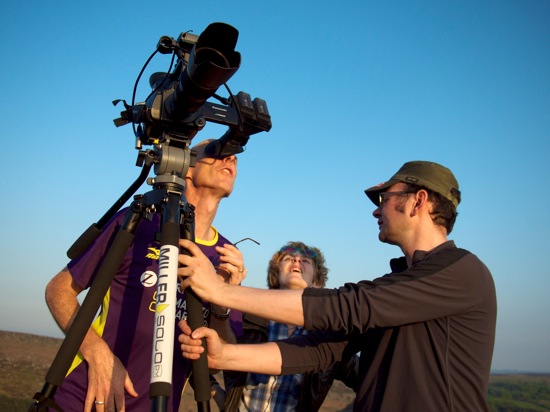
        <![CDATA[<p><img src="http://storycog.com/blog//blog/images/SHU_shoot.jpg" alt="Lining up a shot" title="SHU_shoot.jpg" border="0" width="550" height="412" /> <br />
<em><small>Prof Steve Haake, producer/director <a href="http://www.outofyourmindproductions.com">Anna Starkey</a> and camera op/exec. producer Jonathan Sanderson discuss a shot. Photo by camera assistant Ed Prosser while filming Steve&#8217;s <a href="http://www.richannel.org/collections/2012/engineering-sport">Engineering Sport</a> series for the Ri Channel.</small></em></p>

<p>On his famous seminar <em><a href="http://mckeestory.com/home">Story</a></em>, the irascible (some might say &#8216;charmless&#8217;) Robert McKee spends a good old chunk of time poo-pooing the whole idea of <em>auteurs</em> in film. They&#8217;re defined thus:</p>

<blockquote>
  <p><strong>auteur</strong> <em>n</em> <br />
: <em>a film director who influences their films so much that they rank as their author.</em></p>
</blockquote>

<p>It&#8217;s not quite clear from my notes why McKee goes off on such a rant. Probably a Hollywood thing. Or perhaps because it&#8217;s French. But it&#8217;s a reasonable point anyway, in that the obsessive controlling narcissism shared by directors and writers that <em>everything must be done their way</em> is, for the most part, to be resisted. Even heavily-stylised films like Nicolas Winding Refn&#8217;s <em><a href="http://www.imdb.com/title/tt0780504/?ref_=fn_al_tt_1">Drive</a></em> (which I finally watched and loved this week) don&#8217;t spring solely from the creative genius of their director.</p>

<p>He had help. Bet you.</p>

<p>Yet, somehow, science communication seems to have latched onto thinking that one individual can do it all. They can present! They can write! They can make the oh-so-critical choice of material! They can market themselves! They can find the relevance to all different kinds of audiences! They can sing! Dance! Fly! Every communicator of science worth their salt can do everything, and their every action is surrounded by magical unicorns!</p>

<p>The perceptive reader will have gathered I&#8217;m not a fan of this way of thinking. There&#8217;s a <a href="https://xkcd.com/793/">basic arrogance to science</a>, I think because it&#8217;s so damned hard that everything else must be easier. Right? And to be fair, I do find scriptwriting easier than I found statistical dynamics.</p>

<p>Marginally. Ever so very slightly.</p>

<p>But I think the real reason is a disconnect we have as audiences. When we watch a film we know that the actors are meat puppets &#8212; playing a critical r&ocirc;le, sure, but if the film&#8217;s worth watching there are other strong voices in play, those of the director, writer, cinematographer, production designer, and so on.</p>

<p>What&#8217;s obvious for movies isn&#8217;t always so clear for TV, particularly when the camera is addressed directly. The myth of the author-presenter is so strong that we remember Bronowski, Burke, Attenborough, Johnny Ball. Yet we&#8217;ve no idea who worked with them to realise &#8220;their&#8221; series, nor what their level of creative control was. Brian Cox did not spring fully formed from the loins of Carl Sagan.</p>

<p>He had help. Bet you.</p>

<p>So &#8212; communicators of science: work out what you&#8217;re good at. Get help with the rest. Not coincidentally, StoryCog can help. Jonathan&#8217;s currently working with a former chemistry prof to build his website and marketing message, and just last weekend Alom helped former FameLabbers refocus their performance voice.</p>

<p>We&#8217;re really good at this stuff. Some of it. For the rest, we get help.</p>

<p><a href="mailto:jonathan@storycog.com">Drop us a line</a>.</p>
]]>
        

    </content>
</entry>

<entry>
    <title>Narrative or Descriptive?</title>
    <link rel="alternate" type="text/html" href="http://storycog.com/blog/2013/02/narrative-or-descriptive/" />
    <id>tag:storycog.com,2013:/blog//2.29</id>

    <published>2013-02-26T15:00:10Z</published>
    <updated>2013-02-26T15:06:27Z</updated>

    <summary>Last weekend I was a tutor on the FameLab UK finalists&#8217; masterclass, which was a jolly wheeze and wildly intense. They&#8217;re a smart and capable bunch, FameLabbers, and we put them through the wringer with storytelling and improvisation exercises, shifting...</summary>
    <author>
        <name>Jonathan</name>
        
    </author>
    
        <category term="storytelling" scheme="http://www.sixapart.com/ns/types#category" />
    
    <category term="famelab" label="famelab" scheme="http://www.sixapart.com/ns/types#tag" />
    <category term="performance" label="performance" scheme="http://www.sixapart.com/ns/types#tag" />
    <category term="storytelling" label="storytelling" scheme="http://www.sixapart.com/ns/types#tag" />
    <category term="writing" label="writing" scheme="http://www.sixapart.com/ns/types#tag" />
    
    <content type="html" xml:lang="en" xml:base="http://storycog.com/blog/">
        <![CDATA[<p>Last weekend I was a tutor on the <a href="http://famelab.org/uk">FameLab UK</a> finalists&#8217; masterclass, which was a jolly wheeze and wildly intense. They&#8217;re a smart and capable bunch, FameLabbers, and we put them through the wringer with storytelling and improvisation exercises, shifting of the performance space to video, then onwards to the weirdly out-of-body experience that was directing others and seeing their own work reinterpreted by their peers. Which was hilarious, apart from anything else.</p>

<p>One of the gang dropped me an email today asking for advice about their piece for the final, which I&#8217;ll choose to paraphrase as:</p>

<blockquote>
  <p>&#8220;Should I go for depth and detail, or a simplified overview?&#8221;</p>
</blockquote>

<p>There&#8217;s no correct answer, of course. How well you execute and a modicum of luck play just as large a role as your preparation, deft avoidance of distractions, brisk setting of context, and so on. But for me there are two key thoughts:</p>

<p>The first is that, as a member of the audience, I want satisfying stories. That&#8217;s a very personal judgement, but for me those tend to be the ones with smart ideas that point in interesting directions. They might be nuggets of factual information, but they&#8217;re just as likely to be about perspective, interpretation, or a general mechanism. I want to be bursting with questions, but I don&#8217;t want those questions to be prompted too closely &#8212; as my partner Elin puts it:</p>

<blockquote>
  <p>&#8220;It&#8217;s not how smart you are, it&#8217;s how smart you make your audience feel.&#8221;</p>
</blockquote>

<p>The second thought &#8212; and the core of my reply to the questioner &#8212; is: what sort of storyteller are you?</p>

<p>Do you revel in the process and sequence of narrative, driving on a story or spinning a web of information from which a chain of events resolves, suddenly snapping into narrative clarity? Or do you favour description, conjuring a detailed mental image which locates, directs, and focusses attention?</p>

<p>Where you see your strengths as a writer and performer should inform the shape of the work you do. Sometimes you challenge yourself to develop, and other times you play to your strengths.</p>

<p>So: depth and detail or simplified overview? Emphatically not the latter, because if your overview is best described as &#8216;simplified&#8217; then you&#8217;re doing it wrong. Solve that, and either <em>could</em> work &#8212; so worry less about your work, and more about who <em>you</em> are.</p>

<p>The best part? The finalists&#8217; email response:</p>

<blockquote>
  <p>&#8220;<strong><em>*UCK!!!</em></strong>&#8221;</p>
</blockquote>
]]>
        

    </content>
</entry>

<entry>
    <title>Lens rings</title>
    <link rel="alternate" type="text/html" href="http://storycog.com/blog/2013/02/lens-rings/" />
    <id>tag:storycog.com,2013:/blog//2.28</id>

    <published>2013-02-26T11:43:10Z</published>
    <updated>2013-02-26T11:43:14Z</updated>

    <summary>It&#8217;s only just occurred to me that the camera manufacturers colour-code their lens rings to remind us of their respective cameras&#8217; skin-tone biases. So: Canon &#8212; red. Nikon &#8212; gold. Panasonic &#8212; sort-of muddy grey. I note this as I...</summary>
    <author>
        <name>Jonathan</name>
        
    </author>
    
        <category term="photography" scheme="http://www.sixapart.com/ns/types#category" />
    
    <category term="colour" label="colour" scheme="http://www.sixapart.com/ns/types#tag" />
    <category term="gear" label="gear" scheme="http://www.sixapart.com/ns/types#tag" />
    <category term="grading" label="grading" scheme="http://www.sixapart.com/ns/types#tag" />
    <category term="lenses" label="lenses" scheme="http://www.sixapart.com/ns/types#tag" />
    <category term="postproduction" label="post-production" scheme="http://www.sixapart.com/ns/types#tag" />
    
    <content type="html" xml:lang="en" xml:base="http://storycog.com/blog/">
        <![CDATA[<p>It&#8217;s only just occurred to me that the camera manufacturers colour-code their lens rings to remind us of their respective cameras&#8217; skin-tone biases. So: Canon &#8212; red. Nikon &#8212; gold. Panasonic &#8212; sort-of muddy grey.</p>

<p>I note this as I push a bunch of +magenta and -yellow into my Nikon grade, and watch the vectorscope slide over to the skin line.</p>
]]>
        

    </content>
</entry>

<entry>
    <title>Gear</title>
    <link rel="alternate" type="text/html" href="http://storycog.com/blog/2013/02/gear/" />
    <id>tag:storycog.com,2013:/blog//2.27</id>

    <published>2013-02-17T14:36:04Z</published>
    <updated>2013-02-17T21:11:33Z</updated>

    <summary>A few things that have caught my eye recently: Røde microphones have partnered with Rycote to fit the latter&#8217;s &#8216;Lyre&#8217; mounts to the former&#8217;s videomic range. I&#8217;m a big fan of both companies&#8217; products. They&#8217;re good value and perform well....</summary>
    <author>
        <name>Jonathan</name>
        
    </author>
    
        <category term="photography" scheme="http://www.sixapart.com/ns/types#category" />
    
    <category term="cameras" label="cameras" scheme="http://www.sixapart.com/ns/types#tag" />
    <category term="equipment" label="equipment" scheme="http://www.sixapart.com/ns/types#tag" />
    <category term="gear" label="gear" scheme="http://www.sixapart.com/ns/types#tag" />
    <category term="microphones" label="microphones" scheme="http://www.sixapart.com/ns/types#tag" />
    
    <content type="html" xml:lang="en" xml:base="http://storycog.com/blog/">
        <![CDATA[<p>A few things that have caught my eye recently:</p>

<ul>
<li><a href="http://www.professionalphotographer.co.uk/News-and-Reviews/2013/2/New-partnership-between-Rycote-and-Rode-microphones">Røde microphones have partnered with Rycote</a> to fit the latter&#8217;s &#8216;Lyre&#8217; mounts to the former&#8217;s <a href="http://www.rodemic.com/mics/videomic">videomic</a> range. I&#8217;m a big fan of both companies&#8217; products. They&#8217;re good value and perform well.</li>
<li>Also from Røde: new <a href="http://www.rodemic.com/mics/ixy">iXY</a> stereo and <a href="http://www.rodemic.com/mics/smartlav">SmartLav</a> lavalier mics, both of which use an iPhone (or iPod touch) as the recording device. Not the first of this sort of thing out there (Tascam do an iOS stereo mic attachment), but the SmartLav in particular seems pretty cheap. I&#8217;m tempted to pick up an iXY for the same reason I have an <a href="http://www.olloclip.com">Olloclip</a> and <a href="http://www.studioneat.com">Glif</a> &#8212; to leave in my bag and hence always have to hand.</li>
<li>While I&#8217;m at it: Tascam also make an <a href="http://tascam.com/product/ixz/">XLR interface for iPhones</a>. You read that right. And no, don&#8217;t ask about phantom power.</li>
</ul>

<p>Now, cameras: I very nearly pre-ordered a Panasonic GH3 for video work, but realised that doing so would pretty much lock me into buying the Panasonic X 12-35 and 35-100, and maybe the Voigtländer 25mm. That would make a commendably tiny kit, and the lenses are spectacularly good… but it&#8217;s a lot of money to invest in lenses that are only going to be any use if I have a micro4/3 body to hang them off.</p>

<p>If the right job comes along it could still be the right decision, but in the meantime I&#8217;ve waited. I&#8217;m glad I did &#8212; early reports are suggesting that the <a href="http://www.eoshd.com/content/9586/is-the-cheap-nikon-d5200-a-better-option-than-d800-for-video-no-moire-aliasing-and-good-detail">Nikon D5200</a> is an unexpected beast as a video camera and something of a bargain, while <a href="http://nikonrumors.com/2013/02/01/nikon-d7000-replacement-before-april-more-coolpix-cameras-including-a-p310-replacement.aspx/">rumours suggest a D7100</a> may come along soon. Nikon DSLRs still have some quirks, but I&#8217;ve been surprisingly happy shooting with my D7000 for the last couple of years. If the new Nikons are sharper and avoid moiré they could be budget contenders. I&#8217;ve been tempted by a D800 with <a href="http://mosaicengineering.com">third-party antialiasing filter</a>, but full-frame super-shallow DOF isn&#8217;t beneficial to the way I work.</p>

<p>Nikon-mount glass, of course, can be adapted to fit just about anything out there. Which makes it arguably a better investment than anything else.</p>

<p><em>Update &#8212; here&#8217;s the first decent D5200 comparative test I&#8217;ve seen:</em></p>

<p><iframe src="http://player.vimeo.com/video/59832019" width="500" height="281" frameborder="0" webkitAllowFullScreen mozallowfullscreen allowFullScreen></iframe> <p><a href="http://vimeo.com/59832019">EOSHD Shootout - Nikon D5200 vs Panasonic GH3 (low light)</a> from <a href="http://vimeo.com/eoshd">Andrew Reid</a> on <a href="http://vimeo.com">Vimeo</a>.</p></p>

<p><em>Article explaining the comparison <a href="http://www.eoshd.com/content/9653/nikon-d5200-review">on Andrew&#8217;s blog</a>. As he notes, this isn&#8217;t entirely fair to the GH3, but still… go Nikon!</em></p>
]]>
        

    </content>
</entry>

<entry>
    <title>Inspiration where there is none</title>
    <link rel="alternate" type="text/html" href="http://storycog.com/blog/2012/11/inspiration-where-there-is-none/" />
    <id>tag:storycog.com,2012:/blog//2.26</id>

    <published>2012-11-16T13:07:55Z</published>
    <updated>2012-11-16T13:15:45Z</updated>

    <summary>Jonathan Richards has an interesting post about an unsatisfactory shoot: We were creatively dead on our feet, with little or no grip to spice things up and with empty rooms to shoot and cleaners to dodge… ‘how can I make...</summary>
    <author>
        <name>Jonathan</name>
        
    </author>
    
        <category term="storytelling" scheme="http://www.sixapart.com/ns/types#category" />
    
    <category term="filmmaking" label="film-making" scheme="http://www.sixapart.com/ns/types#tag" />
    <category term="process" label="process" scheme="http://www.sixapart.com/ns/types#tag" />
    <category term="production" label="production" scheme="http://www.sixapart.com/ns/types#tag" />
    <category term="storytelling" label="storytelling" scheme="http://www.sixapart.com/ns/types#tag" />
    
    <content type="html" xml:lang="en" xml:base="http://storycog.com/blog/">
        <![CDATA[<p>Jonathan Richards has an interesting <a href="http://www.jonathan-richards.tv/running-low-on-time/?utm_source=rss&amp;utm_medium=rss&amp;utm_campaign=running-low-on-time">post about an unsatisfactory shoot</a>:</p>

<blockquote>
  <p>We were creatively dead on our feet, with little or no grip to spice things up and with empty rooms to shoot and cleaners to dodge… ‘how can I make this interesting?’.</p>

<p>And the answer is… ‘I’m not sure, quite honestly’.</p>
</blockquote>

<p>We&#8217;ve all done these jobs. They&#8217;re invariably draining and unsatisfying, but the way I look at it is that the problem was set long before you turned up for the shoot. If the script and the plan calls for a bunch of talking-heads shots and cutaways, you&#8217;ve already lost.</p>

<p>If you&#8217;re lucky your interviewee will be charismatic, their story compelling, and your cutaways motivated. Much more likely: you&#8217;re shooting the same bland interview you&#8217;ve done a zillion times before, it&#8217;ll gnaw away at you all the way through the edit, and throughout you&#8217;ll know &#8212; just <em>know</em> &#8212; that nobody&#8217;s going to watch the result anyway.</p>

<p>Personally, I turn most of these jobs down. If a client is convinced that it&#8217;s what their audience needs… well, OK, but other film-makers have more patience than I do for shooting this stuff, and I&#8217;d hope they&#8217;re better at it than I am as a result.</p>

<p>What I&#8217;d rather do is work with a client at an earlier stage, explore what it is they&#8217;re trying to achieve, and think through some different approaches which might help meet objectives. Sometimes &#8212; often? &#8212; that does lead to talking heads, but with a really clear idea about why we&#8217;re in the room. Which leads to a completely different mood on set.</p>

<p>The challenge, often, lies in getting the client to recognise that every film-maker has a different approach, and hence the film they&#8217;re buying reflects their choice of crew.</p>

<p>That is: I try to train my clients to be producers.</p>
]]>
        

    </content>
</entry>

<entry>
    <title>Action</title>
    <link rel="alternate" type="text/html" href="http://storycog.com/blog/2012/11/action/" />
    <id>tag:storycog.com,2012:/blog//2.25</id>

    <published>2012-11-16T12:59:19Z</published>
    <updated>2012-11-16T12:59:24Z</updated>

    <summary> &#8220;Never mistake motion for action&#8221; (Ernest Hemingway) Spot on. (via.)...</summary>
    <author>
        <name>Jonathan</name>
        
    </author>
    
        <category term="storytelling" scheme="http://www.sixapart.com/ns/types#category" />
    
    <category term="maxim" label="maxim" scheme="http://www.sixapart.com/ns/types#tag" />
    <category term="quote" label="quote" scheme="http://www.sixapart.com/ns/types#tag" />
    <category term="wisdom" label="wisdom" scheme="http://www.sixapart.com/ns/types#tag" />
    
    <content type="html" xml:lang="en" xml:base="http://storycog.com/blog/">
        <![CDATA[<blockquote>
  <p>&#8220;Never mistake motion for action&#8221; (Ernest Hemingway)</p>
</blockquote>

<p>Spot on.</p>

<p>(<em><a href="http://thisisnthappiness.com/post/35782208054/never-confuse-motion-with-action-ernest">via</a>.</em>)</p>
]]>
        

    </content>
</entry>

<entry>
    <title>Structure</title>
    <link rel="alternate" type="text/html" href="http://storycog.com/blog/2012/08/structure/" />
    <id>tag:storycog.com,2012:/blog//2.24</id>

    <published>2012-08-29T12:18:21Z</published>
    <updated>2012-08-29T12:18:24Z</updated>

    <summary>A client of mine sent a rough-cut through for comment last night. It&#8217;s great, so while I sent copious notes in timecode detail, that&#8217;s all fiddling around the margins. They&#8217;ve got the hard bits right already. More useful, then, is...</summary>
    <author>
        <name>Jonathan</name>
        
    </author>
    
        <category term="films" scheme="http://www.sixapart.com/ns/types#category" />
    
        <category term="storytelling" scheme="http://www.sixapart.com/ns/types#category" />
    
        <category term="writing" scheme="http://www.sixapart.com/ns/types#category" />
    
    <category term="filmmaking" label="film-making" scheme="http://www.sixapart.com/ns/types#tag" />
    <category term="production" label="production" scheme="http://www.sixapart.com/ns/types#tag" />
    <category term="writing" label="writing" scheme="http://www.sixapart.com/ns/types#tag" />
    
    <content type="html" xml:lang="en" xml:base="http://storycog.com/blog/">
        <![CDATA[<p>A client of mine sent a rough-cut through for comment last night. It&#8217;s great, so while I sent copious notes in timecode detail, that&#8217;s all fiddling around the margins. They&#8217;ve got the hard bits right already.</p>

<p>More useful, then, is lessons to draw from this film to guide the next one. What I wrote applies rather generally:</p>

<ul>
<li><p>How does it open? Start on action, clear statement of intent, etc. Usually, the first page of a script can be thrown away &#8212; come to the action late, and all that.</p></li>
<li><p>Where&#8217;s the story? Not just what is it, but <em>when</em> is it? Knowing where the bulk of it comes allows you to introduce terminology and context early, which smooths the whole film.</p></li>
<li><p>Know how you finish. This applies for each shot as well as for the film overall. What&#8217;s the end-point?</p></li>
</ul>

<p>As ever: grab attention, sustain it, reward it, and close gracefully.</p>

<p>For short factual films, just about everything else flows from that arc.</p>
]]>
        

    </content>
</entry>

</feed>